
We review hundreds of property guidelines each year, and the distinction between these age labels is easily the most misunderstood detail. Both designations fall under the federal Housing for Older Persons Act, but they apply very differently to your family.
If you are comparing 55+ new apartments, this specific rule decides exactly who can sign the lease and live in the unit.
Let’s break down how these two federal categories actually work so you can plan your next move.
What’s the difference between 55+ and 62+ communities?
The core difference between 55 plus vs 62 plus apartments comes down to who must meet the age requirement. A 55+ community requires just one person in the household to be at least 55, while a 62+ community requires every single resident to be 62 or older.
The Department of Housing and Urban Development sets these baselines under the Fair Housing Act. A 55+ property must ensure 80 percent of its occupied units house at least one qualifying older adult. A 62+ property must maintain a strict 100 percent compliance rate for all residents.
We see management companies write their own specific lease terms within these federal boundaries. Two neighboring 55+ buildings can enforce entirely different policies for younger spouses or adult children.
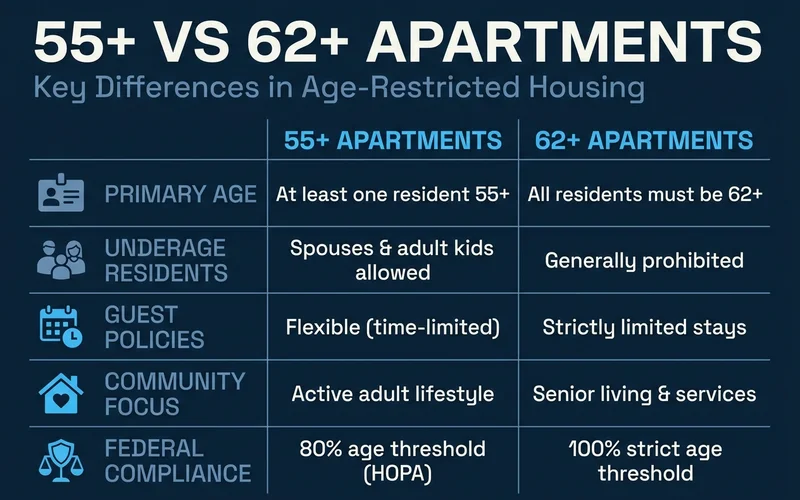
| Rule | 55+ community | 62+ community |
|---|---|---|
| Who must meet the age | Generally at least one resident per household | Generally every resident |
| Other household members | Often allowed, with community rules | Limited exceptions |
| Federal basis | 80% of occupied units with a 55+ resident | All residents 62+ |
Read the community’s rule, not the label
The label tells you the category. The community’s written occupancy rule tells you whether your household fits.
Who in a household can live there?
The person signing the lease and their dependents dictate who can occupy the unit. Federal housing guidelines determine the baseline rules for both property types.
At a 55+ community
Usually, one resident on the lease must be 55 or older. The community holds the right to set the rules for the remaining household members.
Many properties gladly accept a younger spouse or partner. Property managers often use the remaining 20 percent allowance under federal law to provide flexibility for mixed-age couples.
Other buildings set strict minimum ages for any additional residents. We frequently see rules requiring all other occupants to be at least 18 or 19 years old to prevent school-age children from living on site. Always ask for the specific 55+ apartment rules in writing before paying an application fee. If you’re leaving a house for the move, our house to 55+ apartment checklist covers space, fees and paperwork.
At a 62+ community
Usually, every permanent resident in the apartment must be 62 or older. This 100 percent mandate leaves very little room for interpretation.
Some properties do allow a small number of limited exceptions. A legally documented live-in aide or medical caregiver can often reside in the unit without violating the 62 and older apartment requirements.
You will also face strict limits on long-term visitors. Most 62+ leases cap guest stays at two to four weeks per year to ensure younger family members do not become unofficial tenants. Always ask a leasing agent exactly what the community allows before you start the application process.
How are labels verified?
Listing syndicators often display conflicting age requirements across different real estate platforms. A property might show up under one category on a corporate site and a completely different one on a niche directory.
Elate Bent Tree is listed as 62+ by Greystar and as 55+ by 55places. We confirm every single age label directly with the property management office before you apply. This direct verification prevents our clients from wasting money on non-refundable fees.
The latest new builds tracked in the database include Novum Plano, Mera Craig Ranch, and Promenade’s 55+ homes. All age-restricted and income-restricted buildings stay entirely out of our market-rate medians to keep the data accurate.

How is age checked?
Communities verify age at lease signing by requiring a valid government ID for every resident. You must bring proper identification for everyone who will live in the apartment.
Federal law actually requires 55+ communities to audit this information regularly. Property managers must complete a demographic survey every two years to prove to the government that they still meet the 80 percent threshold.
We recommend keeping these acceptable documents handy during your initial property tour to speed up the pre-approval process:
- A state-issued driver’s license
- A valid passport
- An original birth certificate
What about income-restricted 55+ options?
Some age-labeled communities also operate under federal affordable housing guidelines. These properties offer specific income-restricted floor plans alongside their market-rate units.
Promenade currently offers plans reserved for renters making 60 percent of the area median income alongside its standard 55+ homes. Under 2026 TDHCA limits, 60 percent AMI for a two-person household is exactly $58,140.
Keep your financial records ready
These hybrid communities often rely on the Low-Income Housing Tax Credit program, which requires strict income verification.
Our Dallas PFC and income-restricted guide explains the exact paperwork required to prove your eligibility. The application process takes extra time, so start gathering your tax returns now.
Which questions should you ask?
You should ask highly specific questions about occupancy policies before touring any property to verify age restricted apartment household rules. Clarifying these details early saves you significant time.
We highly suggest requesting a copy of the official resident handbook. Reviewing the actual text is much safer than relying on a verbal promise from a leasing agent.
Always ask the property manager these exact questions:
- What is your written occupancy rule for this specific building?
- Can a younger spouse, partner, or certified medical caregiver live in the unit?
- How do you verify age, and what documents do you need at signing?
- Are any of the available units income-restricted?
- What is your exact policy on the maximum number of days a guest or grandchild can stay?
What’s the next step?
Tell us who will live in the unit and their exact ages. We will confirm each community’s specific rule in writing and price the buildings that fit your family.
Finding the right fit takes serious research. Reach out today to Get my shortlist.