
What are income-restricted new apartments?
We have seen a major shift in local housing options lately.
Finding a quality rental often feels like a financial stretch for many employees. This specific program changes that dynamic entirely.
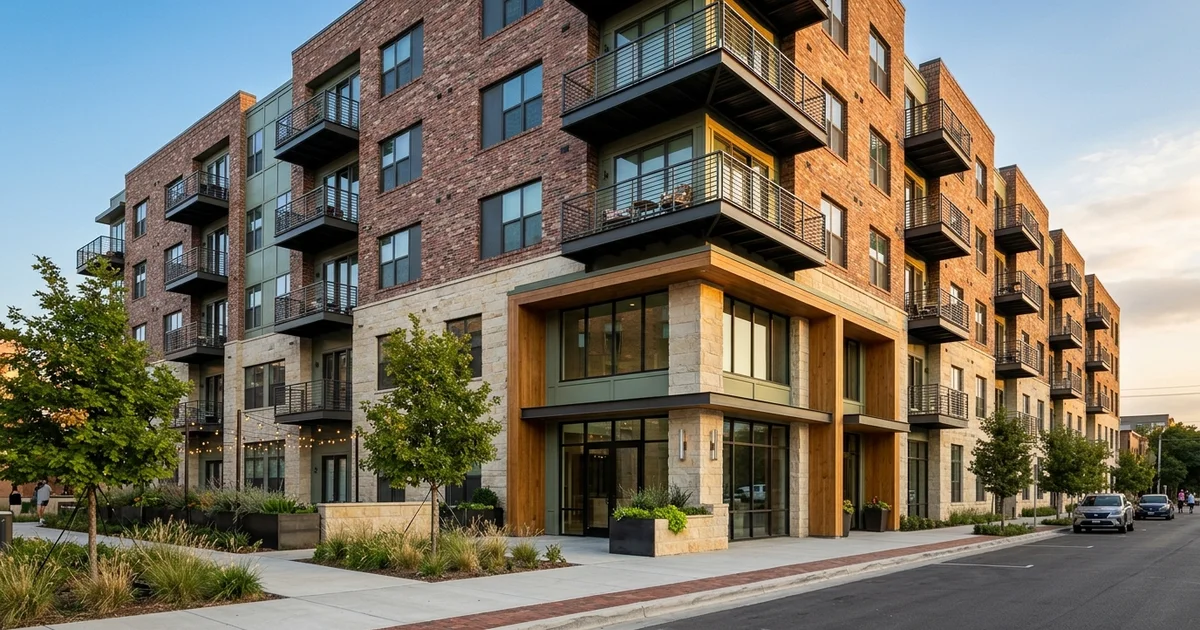
Our team tracks these developments closely to help local residents spot the best opportunities. Some of the newest buildings among new apartments in Dallas reserve specific units for households earning under set income limits. The rent on those units is capped by state and local regulations.
We constantly update our board with three main programs: Dallas PFC apartments, LIHTC, and Essential Worker tiers. These units sit in the exact same new buildings as market-rate units and feature the exact same finishes. The only difference is the paperwork and the monthly price tag.
Our goal here is to explain the data behind these limits and walk through the exact steps to qualify.
What is a Dallas PFC building?
The Dallas Public Facility Corporation (PFC) program directly impacts local costs, which is why renters constantly ask us what is Dallas PFC housing. A Dallas Public Facility Corporation (PFC) partnership gives a private developer a 100% property tax exemption in exchange for reserving a share of units at set income levels.
Our database currently lists several prominent buildings with Dallas PFC labels based on dallaspfc.com data. These properties include:
- The Hayden
- The Caroline
- The Marcus
- Copper Bishop Arts
- CO/OP Singleton
- Oakhouse
- Burnett Lofts
- Banyan Flats
Texas lawmakers reformed these corporations with HB 2071 (2023) to tighten affordability and reporting rules. We always point out that the updated law requires developers to reserve at least 10% of units for renters earning 60% of the area median income (AMI). Another 40% of the building must remain affordable for households at the 80% AMI level.
Annual compliance audits are now handled directly by the Texas Department of Housing and Community Affairs (TDHCA) to ensure strict adherence. Our team monitors these audits to verify that developers maintain the agreed pricing structure for the life of the property.
What about LIHTC and Essential Worker units?
LIHTC (Low-Income Housing Tax Credit) buildings and Essential Worker programs give you a complete picture of the affordable market. The federal LIHTC program issues tax credits to developers to fund affordable units across the country. Our board shows that Cypress Creek at Montfort Drive carries a specific LIHTC label on the local market.
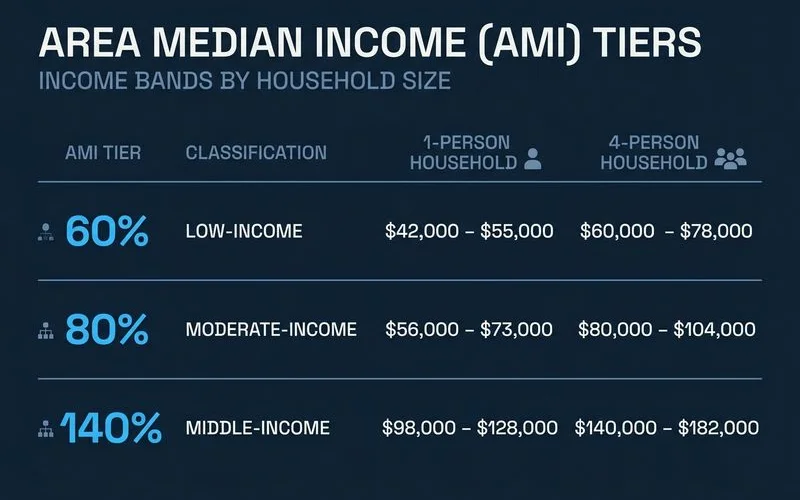
Essential Worker tiers reserve units at several different income levels to support local professionals like teachers and medical staff. The Olsen in Garland offers dedicated tiers at 60%, 80%, and 140% of the area median income (AMI). We highly recommend checking out Promenade in Plano, which offers similar 60% and 80% plans alongside its age-restricted homes.
You can see our 55+ new apartments page for more details on those specific communities. This tiered system supports the demand for workforce housing Dallas professionals desperately need. Our team included the graphic below to illustrate how these different percentage bands typically overlap.
What are the 2026 income limits?
Income limits are established as a percentage of the area median income and get adjusted based on total household size. The Texas Department of Housing and Community Affairs (TDHCA) publishes these updated figures annually. We review the official state guidelines every year to determine the exact income limits for these apartments.
A two-person household aiming for a 60% AMI unit faces a maximum income cap of $58,140. The maximum allowable rent for a one-bedroom unit at that same 60% tier is capped at $1,362.
| Measure | 2026 value |
|---|---|
| 60% AMI, 2-person household | $58,140 |
| 60% AMI, 1-bedroom maximum rent | $1,362 |
Our team pulled these critical data points from the 2026 TDHCA tables for quick reference. An 80% tier allows a significantly higher maximum income. A 140% tier pushes the allowable earning limit higher still.
We will look up the exact limit for your specific household size and the unit’s designated tier. The standard qualification math works backward compared to typical apartments. Market-rate properties require a minimum income, but restricted units strictly enforce a maximum ceiling.
The Rule Flips: Minimum vs. Maximum Our experts see many renters get confused by the math. Market-rate buildings set a strict minimum income, often requiring you to make about three times the monthly rent. Income-restricted units add a firm maximum cap to the equation. We advise you to calculate carefully. You need to earn enough to pay the base rent while staying completely under the designated maximum limit. This balance takes a bit of planning.
How do you qualify?
We guide clients through a specific four-step qualification process to secure the best income restricted apartments Dallas has available. The application requires more documentation than a standard lease agreement. Property managers must strictly verify every detail to maintain their tax-exempt status.
Our recommended checklist helps you prepare the right paperwork in advance. Follow these exact steps to secure your approval:
- The specific tier: Each restricted unit falls under a set tier, such as 60% or 80% AMI.
- Household members: Our team always reminds clients that income limits change drastically depending on exactly how many people will live in the apartment.
- Gross income calculation: Wages, benefits, child support, and certain assets all factor into the total. The community provides a specific form detailing exactly what gets included.
- Documentation and certification: Our experts recommend completing a thorough income certification using recent pay stubs and tax returns at application. Property management usually requires you to recertify this information every 12 months.
The certification process ensures all residents meet the legal criteria for the program. We suggest gathering at least three months of financial records before touring a property. Missing documents often cause frustrating delays in the approval timeline.
Complete accuracy prevents any issues during the community’s annual compliance audit.

Our 3x income rule guide covers the minimum side of the financial test in detail. This resource explains how base income requirements work across the broader Texas market. A solid understanding of both rules makes the leasing process much easier.
Do these buildings accept housing vouchers?
We receive many questions about whether these specialized buildings accept federal housing choice vouchers. Texas lawmakers passed HB 21 in 2025 to radically reform housing finance corporations (HFCs). The law explicitly requires voucher acceptance at all HFC-supported properties by January 1, 2026.
Our legal researchers built this quick comparison to explain the current landscape. Two distinct statutes create a complicated environment for renters. Local authorities must handle these conflicting mandates carefully.
| Legal Code | Primary Impact on Vouchers |
|---|---|
| HB 21 (Section 394.9026) | Mandates voucher acceptance at all HFC-supported properties. |
| Section 250.007 | Prohibits Texas cities from forcing private landlords to accept vouchers. |
We advise clients to verify the status directly, as Dallas PFC buildings operate under slightly different rules than standard HFCs. You should always ask the leasing office about their exact policies before submitting an application fee. Vouchers in the Dallas area rely on ZIP-level Small Area Fair Market Rents (SAFMRs) published by HUD.
Our team appreciates that this localized metric reflects true neighborhood costs. The ZIP-level approach prevents voucher values from being skewed by cheaper or more expensive areas across the city. This system gives families a better chance of securing a unit in a high-opportunity neighborhood.
Why do we keep these buildings out of market-rate math?
We purposefully exclude all 13 income-restricted or age-labeled buildings from our standard market-rate medians. The rents in these specific developments remain strictly capped by government program rules. Including a capped apartment in a neighborhood where standard units cost significantly more artificially depresses the local average.
Our team keeps this data separated for three very specific reasons:
- Data integrity: Distorted statistics confuse renters trying to set a realistic monthly budget.
- Market clarity: A clear separation provides an honest reflection of actual pricing trends for investors and developers.
- Preventing false hope: Our database managers know accurate listings prevent you from falling in love with a floor plan you do not qualify for.
You will notice how we handle this organization visually. Every restricted property on the New Build Board carries a distinct identifying tag. We ensure each one clearly displays a “Who can rent here” label right at the top.
This clear labeling speeds up your search process tremendously. The system guides you directly to the communities that match your specific financial profile.
What’s the next step?
We are ready to help you process these specific income guidelines and find your next home. The demand for affordable apartments in Dallas remains exceptionally high throughout 2026.
Open units in these restricted tiers often get leased within hours of hitting the market.
Our specialists will cross-reference your details against real-time building availability. Tell us your exact household size and current gross income in the contact form. A quick review tells you exactly which restricted tiers you qualify for right now.
We encourage you to reach out today so you do not miss out on a great opportunity. Fill out your information to Get my shortlist and start the process.
The right apartment is out there waiting for you.