
Wondering which electric company Dallas apartment buildings use?
Finding out which electric company Dallas apartment buildings use is a confusing process. Most people assume the city name on the mailing address dictates the utility provider, but the exact street address actually controls the power grid. That geographical detail catches many renters off guard when evaluating new apartments in Dallas.
Two identical buildings located just a mile apart can have completely different billing systems and deposit requirements. We see this confusion happen every week. The dividing line often cuts right through the middle of a popular suburb, meaning your choice depends entirely on the property lines drawn by the state.
Our data as of October 2026 shows that 94 out of 120 buildings let you pick an electric plan, with 85 on Oncor and 9 on TNMP. The rest default to CoServ or Garland Power & Light. This guide explains how to verify your provider and shares exact strategies to avoid unexpected deposits.
What are the four systems?
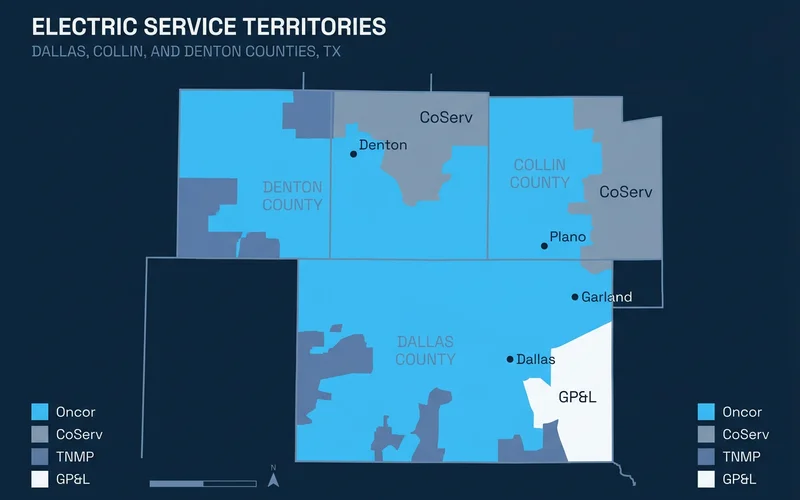
Dallas apartments fall under four specific electric providers: Oncor, TNMP, CoServ, or GP&L. The Public Utility Commission of Texas regulates these physical delivery networks.
Oncor: you pick a plan
Oncor owns the physical poles and wires across most of Dallas and the surrounding suburbs. You don’t buy your monthly power directly from Oncor. Residents must choose a retail electric provider to supply the energy, while Oncor simply delivers it to the meter.
The delivery charges appear as a separate line item on your monthly bill. We closely monitor these rates because they impact every local resident. The PUCT approved a rate increase for Oncor on October 4, 2026.
This recent adjustment pushed the delivery rate to $4.06 a month plus 6.8673 cents per kWh. A standard 1,000 kWh usage month will cost exactly $72.73 just for the delivery portion. You also get access to the Smart Meter Texas portal to track your daily consumption.
TNMP: you pick a plan
Texas-New Mexico Power serves parts of Denton County. This territory covers several major Lewisville buildings, including Whitlow, The Whitley, and Frontera Shores.
You must select a retail electric plan to supply power to a TNMP address. This utility currently charges the highest delivery fees of any major network in the state.
The October 2026 rates show a fixed monthly customer charge of $7.56 plus 7.7710 cents per kWh. Your delivery costs alone will hit $85.27 at 1,000 kWh before your provider adds a single energy charge.
CoServ: no choice
CoServ Electric operates as a member-owned cooperative across parts of Denton and Collin counties. You cannot choose a retail provider in this exclusive zone.
Our team confirmed that properties like Presidium Frisco Square and 11 other local buildings are CoServ-only addresses. Renters must sign up directly with the cooperative to establish service.
New customers face a mandatory $40 connect fee. The company also requires a deposit up to $300 based on a soft credit check.
Garland Power & Light: no choice
GP&L functions as the municipal utility for the city of Garland. The Olsen and four other major Garland buildings rely entirely on this city-run network.
You must register your account directly through the municipal government portal. A standard $200 deposit is required upfront.
This single deposit conveniently covers your electricity, water, and trash services together. Add any deposit and your monthly estimate to your all-in budget for a new DFW apartment.
The dual-territory addresses
Five buildings sit exactly where the CoServ and Oncor service maps overlap. These specific properties are Jefferson Union, Greenway Village, Mirra, Terra, and Jefferson Marquee. We actively confirm the exact meter setups for each one.
Aura Southgate and Jefferson Merritt Park also remain on our confirmation list.
How do you avoid an electric deposit?
A standard utility letter of credit serves as your best tool to secure a CoServ deposit waiver or avoid fees at GP&L. This official document from your previous electric provider proves you paid your bills on time.
CoServ explicitly requires this letter to show 12 months of excellent payment history within the last 24 months. You should ask your current provider to email this document a few days before your move.
Retail providers at Oncor and TNMP addresses use different criteria to evaluate new customers. Here are three common ways to bypass their deposit fees:
- Pass a soft credit check: Many retail companies automatically waive the fee if your credit score lands above 650.
- Provide a payment history letter: Just like the cooperatives, retail providers often accept a letter of credit showing zero late payments in the last year.
- Qualify for state exemptions: Texas law mandates deposit waivers for senior citizens over 65 and legally documented victims of family violence.
How do you compare plans at an Oncor or TNMP address?
The official Power to Choose website lists all available retail plans by your specific ZIP code. The sheer number of options can feel overwhelming for a new Texas resident.
Our clients often miscalculate their estimated usage when shopping for a rate. A typical 1-bedroom apartment in Dallas uses 500 to 800 kWh per month, while a 2-bedroom averages 600 to 900 kWh.
Do not focus entirely on the advertised 2,000 kWh rate because an apartment rarely reaches that threshold. Here are three data-driven tips to secure the best contract:
- Read the electricity facts label. Compare the average price at your realistic usage level of 500 or 1,000 kWh rather than the headline rate.
- Watch for usage tiers and bill credits. Certain plans look incredibly cheap at exactly 1,000 kWh but penalize you heavily if you only use 900 kWh.
- Match the term to your lease. A 12-month plan on a 15-month lease leaves you exposed to a highly volatile variable rate for three months.
New construction is generally very energy-efficient. Your actual usage may run 10% to 15% lower than an older apartment of the exact same size.
Unit exposure also plays a massive role in your final bill. A west-facing unit forces the air conditioning system to work significantly harder during the hot Texas afternoons.
Which areas have which systems?
The service map splits sharply between Dallas, Denton, and Collin counties. When comparing an Oncor vs CoServ apartment, you must verify the exact property location before making any assumptions about your provider.
| Area | What we see | Choice? |
|---|---|---|
| Downtown and most of Dallas | Oncor | Yes |
| Lewisville and parts of Denton County | TNMP at many buildings, CoServ at some | Depends on address |
| Frisco | CoServ at some buildings, Oncor at others | Depends on address |
| Garland | GP&L at The Olsen and four others | No |
Lewisville is where the provider map changes the decision process the most. The Lewisville area page on our site shows the exact split between the different networks.
We highly recommend sorting this out before you cross state lines. Relocating from out of state requires some extra planning, and our moving to Dallas page covers the entire setup before you land.
When should you set up electric?
Setting up electricity at a Dallas apartment requires a bit of lead time. Start the setup process at least three to five business days before your scheduled move-in date.
Texas law technically allows same-day connections, but this often triggers rush fees and weekend blackout periods. Here is the exact order we follow at the move-in stage:
- Confirm the provider assigned to your exact address and unit number.
- Request a utility letter of credit from your current provider if you are moving to CoServ or GP&L.
- Enroll in a retail plan for Oncor or TNMP addresses using your exact lease start date.
- Call CoServ or GP&L directly to start municipal service if you live in a restricted zone.
- Confirm the account is active the day before you pick up your keys.
How do we help?
Our team tracks the exact utility provider for every new property in the metroplex. The electric chip on every New Build Board card clearly shows who serves the address.
This upfront transparency prevents massive headaches when you finalize your paperwork. At the Shortlist stage, we verify the meter situation directly with the community management, staying involved right up until you sign the lease.
At move-in, we help you enroll in the correct plan or start your cooperative service. Our process ensures everything is fully active before you arrive with moving boxes, so you never have to guess which electric company Dallas apartment buildings require. Ready to start your search? Get my shortlist.