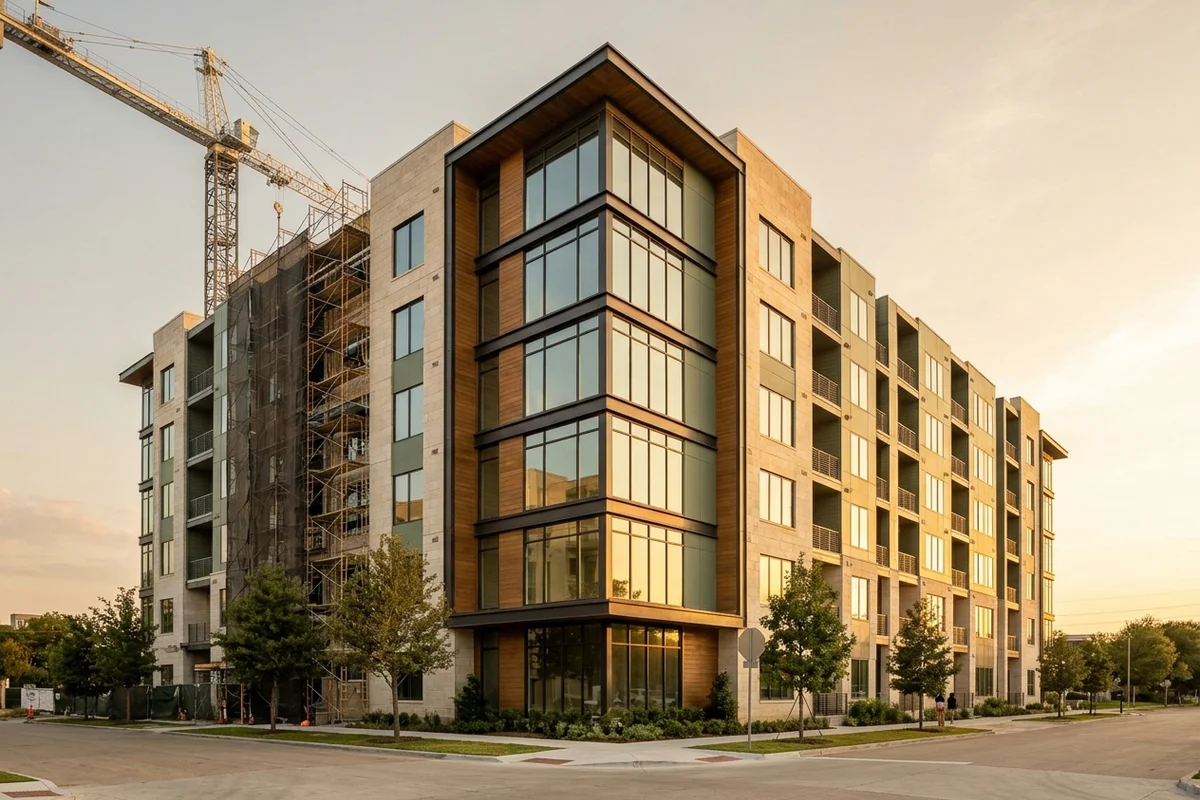
Have you noticed how many cranes are hovering over Dallas right now? We certainly have, especially with over 28,000 new construction apartments opening across DFW in 2026 alone.
Sorting through that massive wave of construction can feel overwhelming for business owners relocating staff or homeowners needing a temporary lease. As a professional service team dedicated to new apartments in Dallas, we created a tool to make the process completely transparent.
Let us walk you through the exact steps we use, and you might be surprised at how easy it can be.
What is the New Build Board?
The New Build Board is our map and card list of every ground-up new construction apartment building on the Dallas side of DFW. We track properties that had their first move-ins between 2024 and 2027 and are still in pre-leasing, lease-up, or their first 24 months.
Older buildings with a new name, renovations, or conversions simply do not make the cut. We know you have already decided you want brand new.
The board skips the old versus new debate entirely. Our tool helps you pick between fresh buildings and price them honestly.
Older buildings only show up as a price reference in the background. We display eight specific values on each card, divided into pricing facts and property details to keep things simple.
Pricing and Fee Details:
- Base rent and the time the price was pulled
- The special, with the term it needs and the date it ends
- Net effective rent, the average monthly rent after the special
- Required fees, from a written fee sheet when available
Total Cost and Commute Details:
- True monthly, net effective plus fees and the bills you opt into
- Year two, what renewal costs from base rent at 0% and +3%
- Electric chip, who delivers power at that address
- Toll chip, whether the likely commute uses the DNT, PGBT or SRT
These details ensure you always know the real numbers. Our team also includes the lease-up stage, the Dallas New Build Score, and the last price check date on every single card.
How does the board price a building?
Dallas property managers are handing out huge concessions in 2026, often reaching 6 to 8 weeks free, because of the current market oversupply. We use one consistent method for every building to cut through these flashy discounts, and you can see it published on how we do the math.
The standard formula keeps landlords honest. Our calculations focus heavily on the total cost of the lease.
- Net effective = (base × months − free rent) ÷ months. N weeks free = base × 12 ÷ 52 × N.
- True monthly = net effective + required fees + electric + water + parking + tolls (opt-in).
- Year two = base × (1 + change) + fees, shown at 0% and +3%.
Here is the calibration example tested against the math. We take 8 weeks free on a $1,500 base if you are staying one year.
Over 12 months, that drops the monthly cost to $1,269. Our next step adds $141.50 in required fees, bringing the total to $1,411.
Year two starts at $1,641.50, representing a painful $231 jump.
Why year two sits on every card
Renewals price from base rent, not the special. A deep special can look cheaper in year one and cost more over two years. This hidden cost is exactly why our team never shows a discount without base rent beside it, or a special without year two.
What Types of New Construction Apartments Are on the Board?
New construction on the Dallas side comes in a few distinct forms, and each one prices differently. We categorize these properties carefully so you can compare apples to apples.
Mid-rise and high-rise apartments
Most Class A multifamily buildings in Dallas are mid-rise properties, usually four to six stories sitting over a garage or wrapped around one. Our team sees high-rise towers popping up constantly in neighborhoods like Uptown Dallas and Victory Park.
Renters should expect more required fee lines in these dense urban areas. We found that towers usually add a separate monthly parking charge, which can easily tack $50 to $150 onto your true monthly cost.
Garden-style communities
Garden-style communities feature two to four stories and surface parking, often located farther out in fast-growing areas like Frisco, Denton, Collin, and Ellis counties. We find that the mandatory property fees tend to be much simpler here.
The commute is where the true cost usually hides. We highly recommend checking if your daily drive requires daily tolls on the DNT or PGBT.
Built-to-rent (BTR) homes and townhomes
Built-to-rent (BTR) communities lease new townhomes and small homes with yards and garages, offering a 1,200+ square foot single-family feel without a mortgage. Our board labels them at parcHAUS, Oxenfree, YardHomes, Crestview Townhomes, Frontera Shores, Meadowlark, and Sonata Estates.
Utilities usually bill you directly, exactly like a traditional house. We created a comprehensive BTR vs apartment guide to walk you through the tradeoff.
Labeled communities
Certain buildings carry a “Who can rent here” label, such as Dallas PFC, LIHTC, Essential Worker tiers, 55+, or 62+. We show the label clearly and keep all 13 of these specific buildings out of market-rate medians.
Income limits strictly dictate who can lease these units. Our team knows that in 2026, the 80% Area Median Income (AMI) limit for a single person in Dallas is roughly $67,840.
This means you might qualify for significantly reduced rent if you earn below that threshold.
What is the Dallas New Build Score?
The Dallas New Build Score runs from 0 to 100. We designed it to measure the financial deal and the lease-up risk, not the neighborhood aesthetics.
A score over 85 usually signals a fantastic concession deal in a highly motivated building.
| Factor | Points | What it measures |
|---|---|---|
| Deal depth | 30 | How much the special lowers your monthly price |
| Price vs nearby | 20 | Net effective against comparable new buildings |
| Year-two risk | 15 | How big the renewal jump looks |
| Lease-up stage | 15 | Where the building is in filling its units |
| Fee disclosure | 10 | Whether we have fees in writing |
| Build complete | 10 | Whether construction is finished |
It never scores location, schools, reviews, or people. We ensure that commission never touches the score, the sort order, the placement, or the alerts.
What profile facts does each building carry?
Daily prices constantly shift in real estate. We check a durable profile by address for every building to lock down the constants:
- Electric provider. Oncor and TNMP addresses let you pick a plan on the open Texas ERCOT grid. CoServ Electric and Garland Power & Light addresses do not offer a choice. A few addresses sit in dual territory, and some rural edges are served by co-ops such as Farmers Electric Cooperative. Moving in this winter? Our note on Oncor’s Oct 1, 2026 delivery rate shows what changed.
- Water billing. Whether the property bills water back to you, and how the allocation works.
- Special district. Whether the address sits in a MUD or FWSD special district, explained in our MUD and FWSD guide. These districts can add 0.5% to 1% to property taxes, which often trickles down into your indirect costs.
- Flood zone. Every board address is FEMA Zone X. Six are in a levee-reduced zone.
- School district. The independent school district (ISD), reported as a fact only.
- Build status. Whether the Certificate of Occupancy is issued for your specific phase.
These hidden details prevent nasty financial surprises on moving day. Our team confirms every single utility and district fact before you sign a lease.
When does the board help most?
Time is money for busy homeowners managing renovations or business owners relocating staff. Our board saves you the most time in three specific situations:
- You have a specific area in mind. Filter directly to your target neighborhood, then compare the buildings on true monthly instead of base rent.
- You are torn between two specials. Use the 24-month compare feature. A lower base rent with a smaller special often wins out over two years compared to a flashy 8-week free promotion.
- You are moving soon. Sort the list by stage. Buildings in active lease-up usually have units available right now, while buildings opening soon may line up perfectly with a later lease end.
Planning ahead gives you the strongest negotiating leverage. We recommend starting your search about 60 days before your ideal move-in date.
How do the board and our concierge work together?
The board serves as the deep research layer. Our concierge team operates as the active phone layer. You can save buildings, compare four favorites, and then send your final list directly to the team.
We make the calls and confirm the unit availability, the exact special, and a written fee sheet the same day during business hours. The final step requires zero effort on your part.
We simply send our top two recommendations and clearly explain the tradeoff.
Public search engines need to see the full picture without generating thousands of near-duplicate pages. We index only the unfiltered board and single-filter views to keep the site architecture clean.
Ready to Find Your Next Home?
Finding the right fit does not have to be a stressful guessing game.
We are ready to help you secure the best deal on new construction apartments across the Dallas area. Send your favorite properties to our concierge team today, and let us handle the heavy lifting for you!