

As a business owner or homeowner, you know how hidden utility costs eat into budgets. These unexpected expenses quickly erode operational margins or personal finances.
When you browse the New Build Board, some building profiles list a special district. Our team frequently encounters properties located in a MUD (municipal utility district) or an FWSD (fresh water supply district).
Both local government units fund water, sewer, and drainage in new developments.
This guide breaks down the data, explains what this means for a mud apartment texas renter, and provides a clear plan of action.
What is a MUD or FWSD?
A municipal utility district (MUD) and a fresh water supply district (FWSD) are special-purpose government entities. They fund and build water, sewer, and drainage infrastructure for new developments.
Our research shows over 4 million Texans live within these districts today. Texas has more than 1,200 active MUDs regulated by the Texas Commission on Environmental Quality (TCEQ).
Here are the core functions of these utility districts:
- Issuing bonds: They sell tax-exempt bonds to pay developers for initial infrastructure costs.
- Levying taxes: They charge property owners a specific rate per $100 of valuation to repay the debt.
- Managing operations: A local, elected five-member board oversees daily water and sewer operations.
A district builds the heavy infrastructure like pipes and treatment plants upfront. It pays for these projects by levying a property tax on the land inside its boundaries.
We see many master-planned communities rely entirely on this model to support new construction. This financing mechanism helped rapidly growing suburbs in Denton, Collin, and Ellis counties get water service quickly.
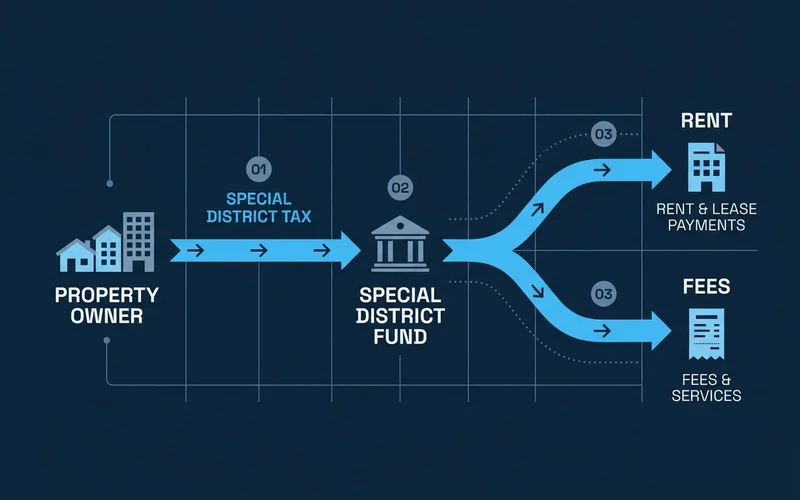
Does a special district cost renters money?
Renters do not pay district property taxes directly. You will never receive a separate fwsd tax texas bill in the mail.
The property owner pays the district tax as part of their total property tax burden. Our 2026 market data indicates MUD tax rates range anywhere from $0.08 to $1.50 per $100 of assessed value.
A $350,000 property could carry an extra $3,500 annual tax bill for the owner. These heavy costs can certainly shape the base rent and administrative fees set by the landlord. But a district does not make a building automatically more expensive than one outside its boundaries.
What to compare instead
Don’t compare buildings on “MUD or not.” Compare true monthly: net effective plus required fees, electric, water and the rest. If a district affects your cost, it shows up there.
We recommend paying close attention to the actual water consumption charges. Some districts set their own aggressive water and sewer rates to cover operational costs.
If your building bills water back to residents, those specific district rates flow directly into your monthly invoice. Ask the leasing office exactly how they calculate water charges and request a recent average bill for a unit like yours.
Where does the board show it?
Our platform clearly displays district information across two distinct layers on each building profile. The feed layer carries dynamic data like price, special offers, and daily fee changes.
The durable profile contains static facts that rarely shift. This section lists the electric provider, water billing method, school district, flood zone, and special district status. As a mud apartment texas renter, you will see this clearly stated if an address sits inside a municipal utility district apartment complex or an FWSD. The flood zone gets the same treatment; see flood notices and levee zones.
We track tax rates through official county databases, including:
- Denton Central Appraisal District (DCAD)
- Harris County Tax Office
- Collin County Central Appraisal District
District tax rates change every single year. Until management confirms the absolute latest adopted rate, the profile will only show the district name.

Which questions should you ask?
You must ask specific questions to uncover potential hidden costs. Leasing agents might not volunteer information about special district apartment fees unless prompted.
Our team suggests using a targeted checklist before signing any lease agreement. This approach protects your cash flow from unexpected utility spikes.
Here are the essential questions you need to ask:
| Question | Why it matters |
|---|---|
| Is the address in a special district? | Confirms the profile fact |
| How is water billed to residents? | District rates may pass through |
| What’s a recent average water bill? | Puts a number on it |
| Are there district-related fee lines? | Identifies standby or fire department fees |
| Does the rate fluctuate seasonally? | Helps project summer utility budgets |
How does this fit your budget?
You should add water estimates to your true monthly expenses the exact same way you would anywhere else. Our all-in budget guide shows exactly where this fits into your financial planning.
If the building bills water through the property, state regulations protect you as a consumer. The Public Utility Commission of Texas (PUCT) oversees these specific tenant billing practices under Texas rule 16 TAC Ch. 24.
This law requires landlords to strictly disclose their exact water allocation method in the lease.
We often see properties use direct submetering or a Ratio Utility Billing System (RUBS) based on square footage and unit occupancy. Management must also share past bills upon request so you can verify the historical averages.
Common PUCT-approved allocation methods include:
- Direct Submetering: You pay exactly for the water flowing through your personal meter.
- Square Footage: The property divides the total bill based on the size of each apartment.
- Occupancy Limits: The bill gets split based on the number of people living in the unit.
What’s the next step?
If a building you like lists a special district, send the property details directly to us. We will personally confirm how the management bills water and verify the exact costs.
As a mud apartment texas renter, this simple step ensures you secure the best possible terms on your next property lease.
Or you can get my shortlist, and a representative will check every single building on it for you.