
Why compare two new apartments over 24 months?
If you want to compare two apartments cost accurately, you need to look at a 24-month timeline. This reveals the true financial impact of a move because most renters stay in one unit for at least two years.
An apartment special comparison over a single year acts as temporary bait. Your second year will always renew based on the full, un-discounted base rate.
We analyze properties on the New Build Board to calculate your total two year apartment cost. This shows you exactly what that discount is worth once the honeymoon phase ends.
National apartment turnover data from 2026 shows that the average renter stays put for 24 months. Moving is expensive, and you need a complete picture of your total housing cost before signing a contract.
Our tool relies on the exact math from the example below to calculate these long-term expenses. Let’s say you plan to stay two years in the same unit.
Six weeks free on a $1,350 base rent costs about $2,700 less over 24 months than eight weeks free on a $1,500 base rent.
We would sign the lease with the lower base rent every single time.
How does the 24-month math work?
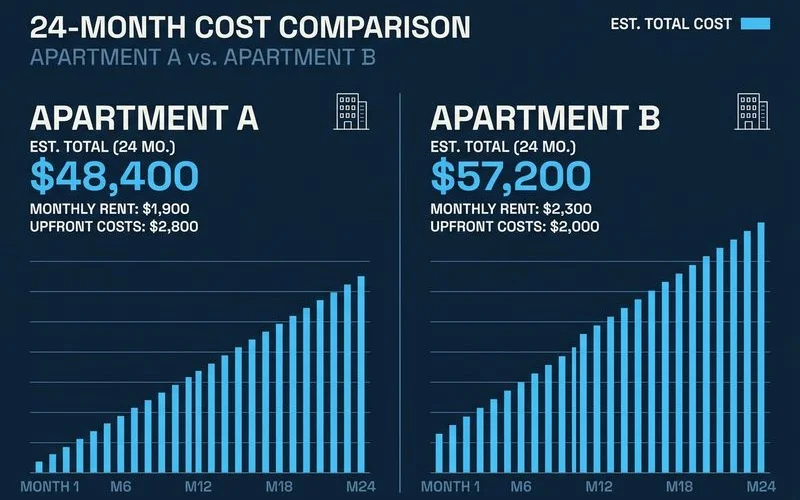
The 24-month math works by calculating your discounted first year, adding your undiscounted second year, and factoring in all mandatory monthly fees. You must understand that the second year is always calculated using the higher base rate, not the discounted effective rate.
For each building, the calculation follows a precise formula.
- Year one rent = base × 12 − free rent, where free rent = base × 12 ÷ 52 × weeks free
- Year two rent = base × (1 + renewal change) × 12
- Fees = monthly fees × 24
- Total = year one + year two + fees
| Line | Building A | Building B |
|---|---|---|
| Base rent | $1,350 | $1,500 |
| Special | 6 weeks free | 8 weeks free |
| Free rent value | $1,869.23 | $2,769.23 |
| Year one rent | $14,330.77 | $15,230.77 |
| Year two rent (0% change) | $16,200.00 | $18,000.00 |
| 24-month rent | $30,530.77 | $33,230.77 |
Illustration, values as of Oct 25, 2026; live page uses the feed.
Building B looks appealing initially because its larger concession saves $900 more during the first year. The problem is that its base rate sits $150 higher, and your renewal pricing will start from that elevated base.
Over a full 24 months, Building B actually costs $2,700 more out of pocket. If both buildings charge the exact same monthly fees, that $2,700 gap remains unchanged. Run this math before touring new apartments, so you only visit the buildings that win over 24 months.
The pattern
When base rents differ, the lower base usually wins over two years unless the special gap is large. Our year-two guide explains why renewals price from base.
What should you add beyond rent?
You should always add mandatory building fees, utility estimates, and commuting costs to find your true cost of living. These hidden expenses frequently wipe out the savings from a seemingly generous rent concession.
Fees
Property fees vary wildly and can drastically inflate your monthly housing budget. Required charges ran between $43 and $226.88 a month at 12 board buildings based on a fee survey from Oct 25, 2026.
The median cost sits at $141.50 per month, which typically includes services like valet trash, pest control, and common area upkeep.
We highly recommend requesting the written fee sheet for each building before making a decision. A simple $50 difference in monthly fees adds a full $1,200 to your total cost over 24 months. Pet rent can also add an extra $25 to $50 per month, so ask about those specific charges if you own an animal.
Year two at 0% and +3%
Renewal offers change based on market conditions, so reviewing multiple scenarios helps you prepare for the future. We display estimates at both 0% and +3% to give you a realistic range of potential costs. J Turner Research reported that the average effective apartment rent increase across the United States in 2026 is 3.14%.
Using that realistic 3% increase, year two costs $16,686 at Building A and $18,540 at Building B. This single adjustment widens the financial gap between the two properties by another $54. Preparing for a 3% bump is a smart strategy in the current rental market.
Tolls
Commuting costs must be factored into your decision if one property forces you to take a toll route to work. A daily commute on the Dallas North Tollway from Frisco to downtown costs $297.78 a month with a TollTag, based on NTTA rates active through June 30, 2027.
That specific route adds over $7,100 to your expenses across a 24-month period. You cannot afford to ignore transportation costs when comparing two locations. A cheaper apartment located far from your office might end up costing you significantly more in toll fees and fuel.
Electric
Electricity costs fluctuate significantly depending on the utility providers available at your specific address. An Oncor address allows you to shop around for competitive plans in the deregulated Texas market, while a CoServ address restricts you to a single provider.
Recent 2026 data from the Energy Information Administration shows that Texas apartments face an average residential rate around 15.88 to 16.99 cents per kilowatt-hour. A standard one-bedroom apartment in Texas uses about 750 kWh per month, resulting in an estimated monthly bill between $111 and $143.
You should add your best estimate for each property based on its size and utility setup.
When does the bigger special win?
The bigger special wins when both buildings share an identical base rent or when you plan to vacate the unit after exactly twelve months. A larger concession is only a true bargain if you avoid the steep second-year renewal hike.
You will come out ahead with the larger discount under a few specific conditions:
- Base rents are close. If both buildings share a similar base price, taking more weeks free is simply a cheaper option.
- You will move after year one. If you only stay 12 months, the second-year renewal rate does not matter. You should only compare the net effective rent plus monthly fees.
- The lower-base building raises renewals harder. This situation is rare, but a massive renewal spike can erase your savings. Check the property’s renewal history online or ask current residents if you can.
Renters who know they are purchasing a house next year should maximize their short-term savings by chasing the biggest first-year concession.
How do we use this at the Compare stage?
After completing the Shortlist stage, we run this exact 24-month calculation on your top choices using real fee sheets, your commuting habits, and your planned length of stay. This comprehensive analysis prevents you from falling for a deceptive short-term discount.
Our team reviews the math and sends you a straightforward breakdown of the two best options. The report highlights the specific tradeoffs in plain words, stating clearly which lease we would sign and what perks you give up by making that choice. Transparency is critical at this stage of the search process.
You can test different scenarios using the 24-Month Compare feature on our tools page by plugging in your own numbers. You can also browse every current market deal on our apartment specials page to see what concessions are available today.
What’s the next step?
Send us the two buildings you are torn between so we can compare apartment specials 24 months out and run the exact numbers for you. If you are starting completely fresh, provide your target move date and your maximum budget.
Our agents will do the heavy lifting to find the most cost-effective options in your desired neighborhood. Take action today and Get my shortlist to begin the process.