
Why does rent jump in year two?
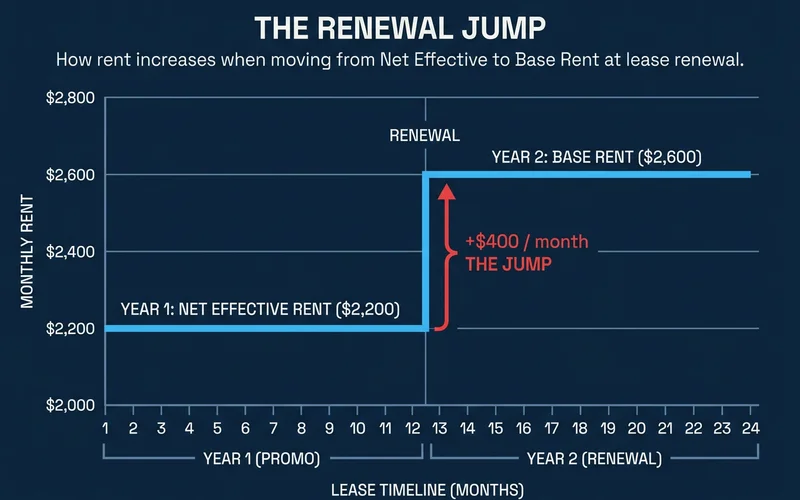
We see this catch renters by surprise constantly as a professional service team reviewing leases. Your year two apartment rent jumps because property managers calculate renewals using the higher base rent instead of the discounted rate.
The temporary concession drops off, leaving you to face a severe apartment rent increase after concession.
Our advice is to look closely when you compare apartment specials, because those initial savings vanish at renewal due to two main factors:
- RealPage data from late 2026 shows average apartment concessions hit 11.1%, equaling about six weeks free on a typical lease.
- At the board median special on October 25, 2026, the average resulting renewal rent jump was about 20%.
How do you calculate year two?
We use a straightforward equation to model this for every property. You calculate a year two apartment rent by multiplying your base rent by the expected renewal increase percentage, then adding your monthly fees. This formula reveals exactly how much your monthly payment will inflate.
Year two = base × (1 + change) + fees
Our models display the math at a 0% change and a +3% change, because renewal offers always vary. Property management software automates this math using the gross rent number, completely ignoring your initial free weeks. Yardi Matrix data from September 2026 shows national average asking rents grew by a modest 0.7%, but landlords frequently aim for higher increases.
| Example | Year one monthly | Year two (0%) | Jump |
|---|---|---|---|
| $1,500 base, 8 weeks free, $141.50 fees | $1,410.73 | $1,641.50 | +$230.77 |
| The Flynn at Live Oak, 8 weeks free, $122.56 fees | $1,285.18 | $1,496.56 | +$211.38 (16%) |
We source this illustration from values active as of October 25, 2026, while the live page uses a real-time feed. At a +3% increase, the first example’s year two rises to $1,686.50. This causes a significant $275.77 monthly jump.
The renewal doesn’t remember your special
Your year-one rent was base minus a discount. The renewal offer starts from base. A deeper special means a bigger step up.
Why do deep specials make bigger jumps?
We constantly remind clients that the base rent dictates all future costs. Deep specials create bigger jumps because they artificially lower your first-year average much further below the actual base price. The larger the initial discount, the steeper the climb back to full price at renewal.
Our team often sees brand-new Class A properties offering two or even three months free to hit their occupancy targets quickly. A massive influx of new apartment supply in 2026 forced buildings to aggressively compete for tenants. Zillow data showed nearly 40% of all rental listings offering some form of concession by late 2026.
We can see this impact clearly on a standard $1,500 base rent in the breakdown below. The building and the base price stay exactly the same. The only difference is the size of the special.
- 4 weeks free on 12 months: net effective $1,384.62, jump to base $115.38
- 8 weeks free on 12 months: net effective $1,269.23, jump to base $230.77
- 12 weeks free on 12 months: net effective $1,153.85, jump to base $346.15
How should you plan for it?
We recommend planning for a year-two jump by evaluating your total costs across a 24-month horizon rather than just looking at the initial discounted term. Proper forecasting prevents sticker shock down the road. Strategic renters secure the best deals by planning ahead for a rent increase after move in special.
Pick by 24-month cost if you’ll stay
Our 24-month comparison guide outlines exactly how to run these specific calculations. If you plan to stay two years, compare the total 24-month cost instead of getting distracted by the year-one net effective rent. A lower base rent combined with a smaller special almost always wins in the long run.
We find that most tenants overlook this simple math during their search. Six weeks free on a $1,350 base costs about $2,700 less over 24 months than eight weeks on a $1,500 base. Letting a massive discount blind you to a high base rate remains a costly mistake.
Budget for year two from day one
We advise clients to check that year two fits their all-in budget right from the start. Financial stress hits hard when the renewal notice arrives and the new price exceeds your comfort zone. If the year-two rate stretches your finances too thin, you are looking at a one-year building.
Run a renewal check at month 10
Our month-10 renewal check guide walks through the exact steps to handle this situation. Around month 10, compare your upcoming renewal offer to current specials at nearby properties. If new competing buildings are still offering weeks free, you have a solid reason to ask for a matched concession.
We always suggest using that market data to negotiate or as a concrete reason to move. Property managers would rather offer a small concession than pay the turnover costs to replace you. Knowing the neighborhood averages gives you a distinct advantage at the bargaining table.
Can you avoid the jump entirely?
We tell renters that you cannot avoid the jump entirely, but you can certainly shrink it. A longer first lease, such as 15 or 18 months, spreads the special across more days and delays the renewal date. A prorated special does not change the mathematical jump, because the renewal still calculates as base minus a discount.
We consistently find that the most reliable lever is simply starting with a lower base rent from day one. Negotiating the base price down yields permanent savings that carry over into every future lease term. Focusing on the base figure protects your budget much better than chasing temporary free rent.
What’s the next step?
Our team tracks this data constantly, and every card on the New Build Board shows your expected year two apartment rent.
You can easily review exactly what happens when the specials expire.
Want us to compare your top buildings over 24 months? Here is how to proceed:
- We are ready to help you map out the financials.
- You just need to reach out to our analysts.
Get my shortlist today to start planning.