
How much are apartment required fees in DFW?
Our professional service team understands the frustration of discovering hidden costs after finalizing a housing budget. The Federal Trade Commission’s spring 2026 crackdown on rental “junk fees” proves this is a widespread headache, making apartment required fees in DFW a major concern for corporate relocations and individual renters alike.
When you compare new apartments in Dallas, the advertised base rent almost always leaves out a second bill for mandatory monthly charges.
We surveyed 12 board buildings on Oct 25, 2026, to calculate the true baseline. Required fees ran $43 to $226.88 a month, with a median of $141.50. Taking out the one 62+ building pushes that median up to $150, which equals $1,800 a year in unadvertised overhead.
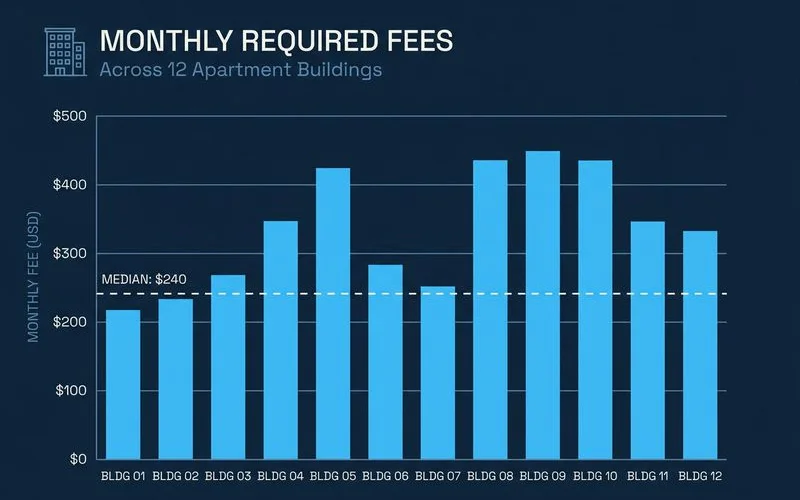
A $183 spread between the cheapest and most expensive building is larger than many specials are worth per month. That massive gap is exactly why these numbers sit on every card on our New Build Board, right next to net effective rent. Let us break down the common charges and show you how to spot them before signing a lease.
What the survey tells you
Two buildings with the same base rent can differ by more than $180 a month once fees are in. Compare true monthly, never base rent alone.
What are the common fee lines?
Fee names vary by community, but the exact same services show up repeatedly across the metroplex. Our review of recent property listings shows that developers package these services to increase revenue while providing convenience. The technology package is the fastest-growing line item in 2026.
Providers like Vitalis Smart Communities often install instant-on Wi-Fi and smart locks before a building even opens. Renters usually pay a $75 to $100 monthly apartment tech package fee.
We also see doorstep garbage collection as a non-negotiable staple. Companies like Valet Living or the locally based Trash Sergeant contract directly with property managers for nightly pickups. You will typically see this billed at $25 to $35 a month.
| Fee line | What it covers | Usually required? |
|---|---|---|
| Valet trash | Doorstep pickup (e.g., Valet Living, Trash Sergeant) | Often |
| Tech package | Internet, Wi-Fi, or smart-home locks | Often |
| Pest control | Routine seasonal pest service | Often |
| Package lockers | Smart delivery hubs (e.g., Luxer One, Fetch) | Sometimes |
| Amenity fee | Pool, gym, and clubroom access upkeep | Sometimes |
| Trash or sewer | Standard utility pass-through from the city | Sometimes |
Some of these charges replace bills you would pay anyway. A bulk tech package that includes Gigabit internet might save you from a separate $80 provider bill. Ask the leasing agent for a complete list of included services before deciding a fee is a bad deal.
What’s the difference between required and optional fees?
Required fees apply to every resident automatically, while optional fees only apply if you actively choose a specific service. Our clients frequently ask how to separate mandatory apartment fees in Dallas from flexible upgrades.
Required fees belong in your non-negotiable monthly budget because you pay them whether you use the service or not. Optional fees, like reserved parking or pet rent, belong in your budget only if they specifically apply to your household.
The dividing line between the two is rarely clear on a standard property website. Some generic “amenity packages” are entirely mandatory for all occupants. Specific “parking fees” sometimes apply to assigned spots that come automatically with the unit.
We highly recommend requesting a written document that categorizes every single line item. The standard 2026 Texas Apartment Association (TAA) lease often lists recurring fixed charges under Paragraph L or Paragraph M. Reviewing these specific paragraphs guarantees you know exactly what you must pay.
Common examples of optional versus required charges under standard Texas guidelines include:
- Always Required: Base rent, valet trash, basic pest control.
- Often Required: Tech packages, common area maintenance.
- Usually Optional: Reserved parking, pet deposits, storage units.
Where do fees show up in the lease?
These extra costs usually appear in the master lease, inside a specific addendum, or directly on your resident portal ledger. Our audit of standard leasing paperwork reveals exactly where property managers document these charges. You can typically find them scattered across three main areas.
- The lease itself, as monthly charges detailed under Paragraph L or M next to base rent.
- An addendum, such as a separate utility, trash, or technology addendum.
- The resident portal ledger, generated by property software after you move in.
The third location is always the one to watch closely. Management systems like Yardi Voyager or RealPage automate the billing process for the portal ledger. If a new charge shows up on your online account that was not on your original paperwork, that is a dispute worth raising in writing immediately.
Our lease red flags guide covers the exact clauses to read before you sign the final digital document.
How do you get a written fee sheet?
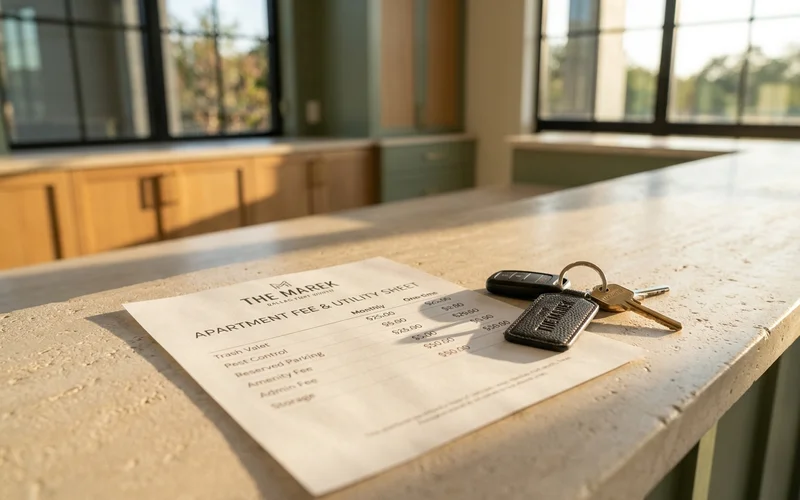
You must ask the leasing office for an itemized list of every monthly charge beyond base rent before you pay any application costs. Our team always requests this documentation upfront because verbal estimates hold no legal weight.
Many newer communities have a printed sheet ready to hand out during a tour. Other properties use an online calculator to generate a quote. Either format works perfectly as long as it includes a date and specific unit number.
We make the calls and request the official breakdown for each building at the Shortlist stage. This outreach happens the exact same day during normal business hours. If a building manager refuses to provide written documentation, we tell you immediately.
Protect Your Upfront Capital
In 2026, standard application and admin fees across Dallas routinely hit $150 to $300. Securing the monthly sheet before paying those non-refundable costs prevents wasted money.
The Dallas New Build Score actually penalizes properties that hide this vital information. Full disclosure is worth a mandatory 10 points out of 100 in our rating system.
How do fees change the special math?
Fees do not get discounted by rent specials because promotional free weeks only apply to the base rent. Our analysts constantly remind clients that a $141.50 recurring charge costs exactly $141.50 every single month, even during the free period. Weeks free apply strictly to the apartment itself, never to the valet trash or tech packages.
Take a standard 2026 calibration example of 8 weeks free on a $1,500 base for a 12-month lease. The net effective rent drops nicely to $1,269.23. Adding $141.50 in mandatory services pushes the actual monthly cash required up to $1,410.73.
| Metric | Rent Only | Rent + Fees |
|---|---|---|
| Base Rent | $1,500.00 | $1,500.00 |
| Monthly Fees | $0.00 | $141.50 |
| Net Effective (8 weeks free) | $1,269.23 | $1,410.73 |
| Year 2 Monthly (No increase) | $1,500.00 | $1,641.50 |
We project that year two, calculating base plus services with a zero percent increase, will jump to $1,641.50. This illustration uses values as of Oct 25, 2026, while the live page uses the direct feed.
These charges also carry over and compound into year two. If a property manager raises a service cost at renewal, your total rent jump gets noticeably larger. We show year two at zero percent and a positive three percent so you can see the realistic range.
The apartment specials page on this site displays every current promotion with the mandatory costs listed right beside it.
Can you lower your fees?
You rarely have the power to lower required fees because they are set system-wide across the entire building. Our experience shows that leasing staff simply cannot waive a building-wide technology or valet trash fee for an individual unit. Management software platforms like RealPage lock these recurring charges to ensure compliance and consistent revenue.
Your effort is much better spent negotiating on items that actually move during lease-up phases. Property managers need high occupancy rates in 2026 due to tight Dallas market competition, giving you leverage on several specific terms:
- Extra weeks of free rent
- Discounted or free assigned parking
- Waived upfront amenity or application deposits
Our negotiation guide provides the exact details on where to push back.
What’s the next step?
Add these apartment required fees in DFW to every building you compare, and get them in writing before you pay an application fee.
Our all-in budget guide shows exactly where these specific costs fit into your final monthly number. Taking the time to build a comprehensive spreadsheet prevents painful financial surprises on move-in day.
You can also get my shortlist directly to save time. We will happily contact the properties and request the detailed fee sheets on your behalf.